
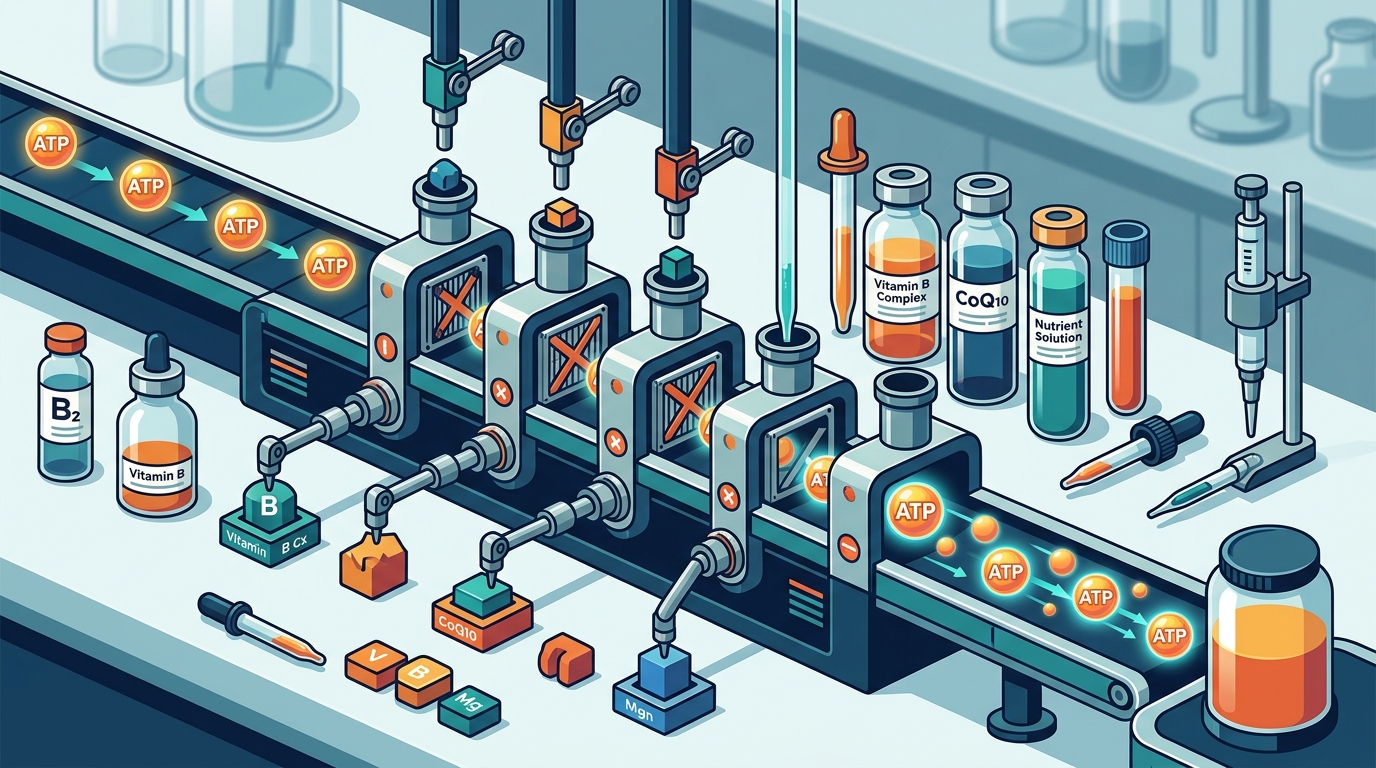
Low energy is rarely a willpower issue. More often, it is a supply-chain problem inside your cells. When even one cofactor is missing from the biochemical assembly line that produces adenosine triphosphate (ATP), the entire system slows down. Below, we map five clinically recognized bottlenecks in cellular energy metabolism and explain exactly which nutrient therapies can clear each one.
A Quick Primer: How Your Cells Manufacture Energy
Every cell depends on mitochondria—tiny organelles that convert nutrients into ATP. As researchers at PMC describe, cells consume sugars, amino acids, and fatty acids, shuttling them into the tricarboxylic acid (TCA) cycle. Electrons stored in NADH and FADH₂ then flow through the electron transport chain (ETC) to drive ATP synthase. This process, called oxidative phosphorylation (OXPHOS), generates the vast majority of your cellular fuel.
When the raw materials for any step in this chain are scarce, ATP output drops—and you feel it as fatigue, brain fog, or slow recovery. The five bottlenecks below represent the most common points of failure.
Bottleneck 1 — Depleted NAD⁺ Levels
Why It Matters
Nicotinamide adenine dinucleotide (NAD⁺) is the electron shuttle at the heart of energy metabolism. Without adequate NAD⁺, cells cannot efficiently transfer electrons from food-derived substrates into the ETC. NAD⁺ also activates sirtuins—regulatory proteins that influence mitochondrial biogenesis and metabolic flexibility. Research published in Signal Transduction and Targeted Therapy notes that cellular NAD availability regulates SIRT1 and is influenced by fasting, caloric restriction, and exercise, while high-fat diets and inflammation reduce it.
Nutrient Therapy Solution
NAD⁺ infusions deliver the coenzyme directly into the bloodstream, bypassing digestive losses. At D'NuVi Wellness & Hydration, NAD⁺ infusions are used to enhance cellular energy production and cognitive function. Oral precursors such as nicotinamide riboside (NR) and nicotinamide mononucleotide (NMN) offer a more convenient daily option, though bioavailability is lower than intravenous delivery.
Practical Tip
Pair NAD⁺ support with time-restricted eating or moderate exercise. Both naturally raise NAD⁺ levels by activating AMPK, the cellular energy sensor that promotes mitochondrial biogenesis through PGC-1α.
Bottleneck 2 — B-Vitamin Cofactor Gaps
Why It Matters
B vitamins do not create energy on their own—they enable the enzymes that convert food into ATP. Thiamin (B1) feeds carbohydrates into the energy pathway, riboflavin (B2) is required for FAD in the mitochondrial respiratory chain, and niacin (B3) supports NAD⁺ synthesis. Deficiencies in even one B vitamin can stall the entire metabolic cascade.
Nutrient Therapy Solution
A clinical-grade B-complex IV drip or intramuscular injection delivers all eight B vitamins in bioavailable form. For targeted mitochondrial support, practitioners often combine B-complex with magnesium and taurine—a combination that also supports neurotransmitter function and sleep quality.
Who Benefits Most
- People on restrictive diets (vegan, keto) with limited B12 or thiamin intake
- Individuals with digestive conditions that impair absorption (celiac disease, Crohn's, SIBO)
- Those under chronic stress, which accelerates B-vitamin depletion
Bottleneck 3 — CoQ10 Decline
Why It Matters
Coenzyme Q10 lines the inner mitochondrial membrane, serving dual roles: it is a critical electron carrier in the ETC and a fat-soluble antioxidant that neutralizes free radicals before they damage mitochondrial DNA. The body produces CoQ10 naturally, but production declines with age. Foods contain only small amounts, making it difficult to obtain enough from diet alone.
Nutrient Therapy Solution
Ubiquinol (the reduced, active form of CoQ10) is better absorbed than standard ubiquinone supplements. IV formulations or liposomal oral delivery can further improve uptake. Studies have shown that supplementing NADH combined with CoQ10 increases ATP production in chronic fatigue patients, making this combination a cornerstone of energy-focused nutrient therapy.
Food Synergies
Organ meats, oily fish, and olive oil contain modest amounts of CoQ10. A diet high in leafy green vegetables also supports CoQ10 antioxidant levels in the blood, creating a nutritional foundation that supplements can build upon.
Bottleneck 4 — Impaired Fatty-Acid Shuttle (Carnitine Deficit)
Why It Matters
Fatty acids store roughly 39 kJ/g of energy compared to 16 kJ/g in glucose, making them a major fuel source—especially during fasting, exercise, or metabolic stress. However, long-chain fatty acids cannot cross the mitochondrial membrane on their own. They require carnitine to shuttle them inside via the CPT1/CPT2 transport system.
Nutrient Therapy Solution
- L-Carnitine: Supports systemic energy and cardiovascular health. Ideal for exercise recovery and general fatigue.
- Acetyl-L-Carnitine (ALCAR): Crosses the blood-brain barrier and is preferred for brain fog and cognitive sluggishness.
Both forms are available as IV push, intramuscular injection, or oral capsule. IV delivery is preferred when rapid repletion is needed or when gut absorption is compromised.
Bottleneck 5 — Oxidative Stress Overload
Why It Matters
The ETC naturally generates reactive oxygen species (ROS) as a byproduct of ATP synthesis. In healthy amounts, ROS serve as signaling molecules. When antioxidant defenses are overwhelmed, however, ROS damage mitochondrial membranes, enzymes, and DNA—leading to a vicious cycle of declining energy output and rising inflammation. Key antioxidant systems depend on micronutrients including selenium, zinc, vitamin C, vitamin E, and glutathione.
Nutrient Therapy Solution
Glutathione IV infusions provide the body's master antioxidant directly to cells. Vitamin C drips act as both a water-soluble free-radical scavenger and an enzyme cofactor. Alpha-lipoic acid is unique among antioxidants because it is both water- and fat-soluble, protecting the entire mitochondrial structure.
A Word of Caution
More is not always better. Research indicates that an overload of certain nutrients, such as high-dose iron combined with vitamin C, may paradoxically increase oxidation and cell injury. Excess antioxidant supplementation over long periods may also suppress mitochondrial biogenesis. This is why clinician-guided dosing matters.
IV Nutrient Therapy vs. Oral Supplements: When Does Intravenous Delivery Make Sense?
IV nutrient therapy delivers vitamins and minerals directly into the bloodstream, allowing for better absorption than oral supplements. This bypasses common barriers such as low stomach acid, enzyme deficiencies, or intestinal permeability. The approach originated with the Myers' Cocktail—a formulation containing B vitamins, vitamin C, magnesium, and calcium—and has since expanded to include NAD⁺, glutathione, amino acid blends, and more.
| Factor | IV Delivery | Oral Supplements |
|---|---|---|
| Bioavailability | Near 100% | Variable (10–80% depending on nutrient) |
| Speed of effect | Minutes to hours | Days to weeks |
| Best for | Acute depletion, malabsorption, rapid repletion | Daily maintenance, mild deficiencies |
| Convenience | Clinic or concierge visit required | At-home daily use |
| Cost | Higher per session | Lower per dose |
A practical strategy combines periodic IV sessions (monthly or quarterly) for deep repletion with daily oral supplementation to maintain optimal levels between infusions.
Lifestyle Amplifiers: Nutrients Work Better When Your Habits Support Them
No supplement can outperform a destructive lifestyle. These evidence-backed habits prime your mitochondria to get maximum value from nutrient therapy:
- Movement with intent: Moderate aerobic exercise activates AMPK and PGC-1α, the master regulators of mitochondrial biogenesis. Even a brisk 30-minute daily walk counts.
- Strategic fasting windows: Time-restricted eating (12–16 hour overnight fast) elevates NAD⁺ levels and triggers autophagy, which clears damaged mitochondria so healthy ones can multiply.
- Prioritize sleep: Growth hormone peaks during deep sleep, supporting mitochondrial repair. A consistent bedtime is a free metabolic intervention.
- Reduce ultra-processed food: Refined sugars, processed flours, and preservatives cause inflammation and burden mitochondria with extra detoxification work.
- Manage chronic stress: Cortisol diverts resources away from repair pathways. Breathwork, meditation, or even brief nature exposure lowers the metabolic tax of stress.
Key Takeaways
- Cellular energy depends on a precise supply chain of cofactors; a single missing nutrient can bottleneck the entire system.
- The five most impactful metabolic bottlenecks involve NAD⁺ depletion, B-vitamin gaps, CoQ10 decline, carnitine deficits, and oxidative stress overload.
- IV nutrient therapy offers near-complete bioavailability and rapid effect, making it ideal for acute depletion or malabsorption.
- Oral supplementation remains valuable for long-term maintenance between IV sessions.
- Lifestyle factors—exercise, fasting, sleep, whole-food diet, and stress management—amplify the benefits of any nutrient protocol.
- Clinician-guided testing and personalized dosing prevent both under- and over-supplementation.
Frequently Asked Questions
What nutrients are most important for mitochondrial ATP production?
The core cofactors include NAD⁺ (from vitamin B3), FAD (from vitamin B2), CoQ10, L-carnitine, magnesium, and alpha-lipoic acid. B vitamins enable enzymes that convert food into ATP, CoQ10 shuttles electrons through the respiratory chain, and carnitine transports fatty acids into the mitochondria for oxidation. Deficiency in any one of these can measurably reduce energy output.
How does IV nutrient therapy differ from taking oral vitamins?
IV nutrient therapy delivers vitamins and minerals directly into the bloodstream, bypassing the digestive system entirely. This provides near-100% bioavailability compared with the variable absorption rates of oral supplements. IV delivery is especially beneficial for individuals with gut issues, severe depletion, or conditions that impair nutrient absorption.
Can you take too many antioxidants for mitochondrial health?
Yes. While antioxidants protect mitochondria from oxidative damage, prolonged high-dose supplementation may suppress mitochondrial biogenesis—the process by which cells build new mitochondria. An overload of certain combinations, such as iron plus vitamin C, can also increase oxidation. Professional dosing guidance is important.
What lifestyle changes boost cellular energy alongside nutrient therapy?
Regular moderate exercise, time-restricted eating, quality sleep, a whole-food diet, and chronic-stress management all activate pathways (AMPK, PGC-1α, sirtuins) that promote mitochondrial biogenesis and metabolic flexibility. These habits compound the effects of targeted nutrient supplementation.
Who should consider NAD⁺ infusion therapy?
NAD⁺ infusions may benefit people experiencing persistent fatigue, cognitive decline, post-illness recovery challenges, or age-related energy loss. Because NAD⁺ levels naturally decrease with age and chronic inflammation, intravenous delivery can rapidly restore cellular reserves. A clinician should evaluate your baseline NAD⁺ status and overall health before recommending a protocol.